


Precision Without the Pressure: Why Integrated Airway Design Trumps the LMA The Case for Integrated Airway Management
Why Clinicians Should Reconsider How They Approach Monitoring and Ventilation
For decades, airway management and respiratory monitoring have existed as separate concerns. Clinicians place an oropharyngeal airway (OPA) to maintain patency and facilitate ventilation, then add a separate sampling port or adapter to monitor end-tidal carbon dioxide (EtCO₂). It is a functional approach—but it is also fragmented, introduces unnecessary complexity, and creates avoidable clinical compromise.
Recent clinical evidence challenges this conventional separation. A landmark study by Casati et al. examined how different supraglottic airways performed during mechanical ventilation, comparing cuffed oropharyngeal airways with laryngeal masks (LMAs). The findings were striking: end-tidal CO₂ sampling via an oropharyngeal airway provided CO₂ readings just as accurate as those from an LMA, with an arterial-to-end-tidal CO₂ difference of 0.3 ± 0.26 kPa, compared with 0.4 ± 0.3 kPa for the LMA.
What makes this result important? It establishes that oropharyngeal airways—when properly designed—can reliably support high-fidelity capnography monitoring. This raises a better question: why keep these functions separate?
The Problem with Conventional Approaches
Traditional oropharyngeal airways serve their primary purpose—maintaining airway patency through tongue displacement—but they do so with inherent limitations:
- Patency depends on guesswork: Basic rigid airways offer limited control. If the tongue position isn’t ideal, ventilation suffers. The research noted that a significant portion of patients using traditional adjuncts required repeated airway manipulation to maintain adequate ventilation—a reminder that patency is not guaranteed.
- Capnography requires workarounds: Standard airways lack a dedicated sampling port. Clinicians must improvise—taping a nasal cannula to the mouth or using unstable adapters. Each workaround introduces a potential source of error or disconnection.
- Oxygen and suction are compromised: Adding supplemental oxygen or clearing secretions without removing the airway becomes cumbersome. Multi-tasking with separate tools reduces efficiency and increases the risk of airway instability.
- Monitoring is an afterthought: When EtCO₂ sampling is added as an “extra” rather than a core function, reliability suffers.
The CapnoFlow Solution: Integration as a Design Philosophy
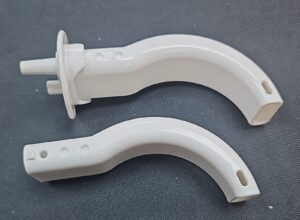
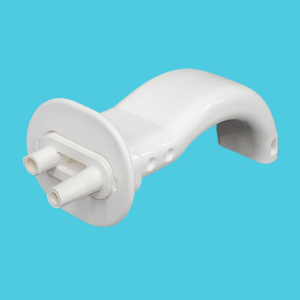
Arete believes that the OPA should not be a passive piece of plastic, but a management hub. CapnoFlow fundamentally rethinks the integrated oropharyngeal airway by building key clinical functions into a single, thoughtfully engineered device:
- Adjustable Tongue Displacement: The anatomically designed section actively positions the tongue for optimal patency, reducing the need for manipulation and improving ventilation reliability.
- Dedicated EtCO₂ Sampling Port: Rather than retrofitting CO₂ monitoring, CapnoFlow incorporates a purpose-built sampling channel. This design directly reflects the clinical principle validated by Casati et al.—that oropharyngeal airways can accurately support capnography when properly engineered.
- Integrated Oxygen Delivery Channel: Supplemental oxygen is built in, eliminating the need for separate delivery devices and streamlining the clinical workflow.
- Suction Access Without Removal: A dedicated suction port allows airway clearance without compromising the airway itself—a practical advantage that speeds procedures and reduces patient handling.
- Reinforced Bite-Block Functionality: A robust bite-block prevents airway occlusion and improves stability throughout the procedure.
What the Evidence Tells Us
The Casati study established a critical baseline: when an oropharyngeal airway is properly designed, capnometry via that device is reliable enough for clinical decision-making. The researchers concluded that end-tidal carbon dioxide determination is as accurate an indicator of PaCO₂ via the oropharyngeal airway as it is via a laryngeal mask.
This is the clinical permission slip that integrated airway design needed. If we know that oropharyngeal airways can support accurate EtCO₂ monitoring, the logical next step isn’t to add more separate devices—it’s to integrate all necessary functions into a single, purpose-built system.
Why Integration Matters in Actual Practice
Beyond the research, clinicians understand the daily reality of the bedside:
- Fewer disconnections mean a lower likelihood of losing the waveform or the airway itself.
- A single-device workflow means faster setup, less mental load, and fewer opportunities for error.
- Built-in functionality means no improvisation is needed for oxygen or suctioning.
- Optimized design ensures each feature supports the others (e.g., proper tongue positioning improves EtCO₂ waveform quality).
CapnoFlow’s integrated approach reflects how modern airway devices should evolve: by anticipating clinician needs and engineering solutions into the core design, rather than treating monitoring, ventilation, and airway management as separate problems.
Conclusion
Clinical evidence supports what experienced practitioners already sense: conventional airway management separates concerns that should be unified. CapnoFlow represents the logical evolution of airway design—integrating patency, monitoring, oxygen delivery, and suctioning into a single device that is easier to use, more reliable, and grounded in the principles validated by clinical research.
The Casati study showed us that oropharyngeal airways can deliver the monitoring accuracy clinicians need. CapnoFlow shows us what that principle looks like when fully realized in clinical practice.
Comments are closed