

The Limits of the Cuff: Why Integrated Design Beats Mechanical Complexity
Cervical spine precautions, manual in-line stabilization, and difficult mask ventilation: How CapnoFlow overcomes the limitations of basic and cuffed tools.
The scenario is a nightmare for any anesthesia provider: a trauma patient with a suspected cervical spine injury. You are performing manual in-line stabilization (MILS)—the head cannot move, the neck cannot flex. You are fighting against anatomy and physics. Now, assume your intubation is delayed. You need to ventilate with a face mask, but the constraints of the situation are causing your tidal volumes to plummet. You are buying time, but you are barely buying enough.
This high-stakes scenario was the focus of a prospective, randomized crossover study by Koga et al., published in the Journal of Clinical Anesthesia. The study compared three conditions: no device, the standard Guedel-type airway, and the cuffed oropharyngeal airway (COPA). The results were clear—the cuffed device outperformed the Guedel, delivering 19% higher tidal volumes and showing superior fiberoptic positioning.
On the surface, this suggests that “more cuff equals more safety.” But for the modern clinician, this raises a critical question: Is a cuff the only way to achieve stability, or is there a more efficient way to manage the airway without adding the complexity of an inflatable seal?
The Hidden Cost of the Cuff
While the COPA outperformed the Guedel, the reliance on an inflatable cuff introduces its own set of clinical challenges. Cuffs can over-inflate, causing mucosal pressure; they can under-inflate, leading to leaks; and they require a separate inflation step in an already stressful emergency sequence. Furthermore, cuffs can be cumbersome when transitioning to a definitive airway or when managing secretions.
The Guedel airway is too simple—it’s a passive stent that often fails in constrained scenarios. The cuffed airway is a mechanical improvement, but it remains a “blind” tool. It solves the seal problem, but it does nothing to address monitoring, oxygenation, and suctioning.
The CapnoFlow Evolution: Intelligence Over Inflation
Arete believes that the answer to difficult airway management isn’t just a better seal—it’s better integration. The Koga study proved that we need a device that actively manages the airway geometry to ensure patency. CapnoFlow achieves this not through a cumbersome cuff, but through superior, adjustable design and integrated functionality.
Instead of relying on a cuff to create a seal, CapnoFlow focuses on the three pillars of airway stability: Geometry, Visibility, and Maintenance.

- Optimized Geometry (The “Active” Displacement): Like the COPA, CapnoFlow is designed for superior tongue displacement. By optimizing anatomical fit, it helps maintain a patent airway even in constrained positions (like MILS), providing the ventilation benefits seen in the Koga study without the risks associated with cuff inflation.
- Integrated Visibility (The EtCO₂ Port): The cuffed airway in the Koga study was “superior” because it was viewed via fiberoptic bronchoscopy. But clinicians don’t have a bronchoscope in every crash cart. CapnoFlow builds a dedicated EtCO₂ sampling port directly into the device. You don’t need a fiberoptic scope to know the airway is patent—the capnography waveform tells you in real-time.
- Integrated Maintenance (The Suction Port): One of the greatest risks in a constrained airway is the accumulation of secretions. While a cuffed airway creates a seal, it can also “trap” secretions. CapnoFlow provides integrated suction access, allowing you to clear the airway without removing the device and without breaking the ventilation cycle.
- Integrated Oxygenation: By building the oxygen delivery channel into the device, CapnoFlow ensures the patient receives maximum oxygenation during the moments when tidal volumes are most critical.
Beyond the “Seal”: A New Philosophy of Care
The Koga study showed that when manual in-line stabilization is required, a passive Guedel airway is often insufficient. However, the leap from a Guedel to a cuffed airway is mechanical. The leap to CapnoFlow is a leap in philosophy.
Arete’s perspective is that the clinician shouldn’t have to choose between a “simple but leaky” device and a “sealed but blind” device. By integrating monitoring and suction into an anatomically optimized oral airway, CapnoFlow provides the clinical benefits of the cuffed device—higher reliability and better patency—without the drawbacks of cuff management.
Design That Performs
The research is detailed: the standard Guedel airway is often inadequate for the most challenging ventilation scenarios. But the answer isn’t simply to add a cuff. The answer is to add capability.
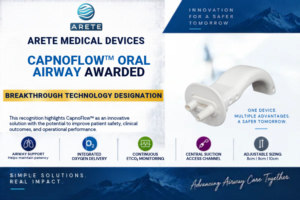
By combining advanced anatomical design with integrated EtCO₂ monitoring, oxygen delivery, and suctioning, CapnoFlow provides a superior alternative for the trauma bay and the operating room. It offers the stability needed for the most difficult patients, the data needed for the most cautious clinicians, and the efficiency needed for the most stressful moments.
Don’t just seal the airway—manage it. That is the Arete standard.
Comments are closed