
What if your oropharyngeal airway did more than ventilate? Exploring how integrated design improves airway management in high-risk patients.
The Evolution of Oropharyngeal Airway Design
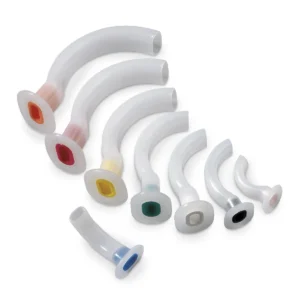
For generations, the Guedel oral airway has been the gold standard—a simple, reliable tool that maintains airway patency through passive tongue displacement. It works because it does one job well: it creates space for ventilation. But modern anesthesia management demands more. Clinicians need not just patency, but also reliable respiratory monitoring, flexible intubation capabilities, and integrated oxygen delivery. A 2021 prospective randomized controlled trial by Abrons et al. published in BMC Anesthesiology offers important insights into how advanced airway design can meet these evolving demands—and points the way toward the next generation of integrated airway solutions like CapnoFlow.
Understanding the Clinical Problem: Difficult Mask Ventilation and Device Limitations
Difficult mask ventilation (DMV) remains a significant challenge in anesthesia. The incidence of difficult mask ventilation ranges from 1–5%, and it rises substantially in obese or anatomically challenging patients. While the Guedel oral airway is widely used to improve ventilation, it operates on a simple principle: passive tongue displacement. The airway is static, the tongue is pushed down, and ventilation proceeds—when it works.
But what about patients with anatomic challenges? What about clinicians who need more control over tongue positioning? And critically, what about the modern reality that clinicians need real-time capnography data while they’re managing the airway itself?
These questions drove the design of the Articulated Oral Airway (AOA), a novel device that shifts from passive to active tongue displacement. The concept is mechanically elegant: instead of relying on static geometry to hold the tongue down, the AOA uses a hinged design that allows active tongue displacement when needed. This design principle opens possibilities that a standard Guedel airway cannot offer—including a larger lumen, compatibility with flexible scope intubation, and improved control in difficult cases.
What the Abrons Study Revealed About Advanced Airway Design
Abrons et al. conducted a rigorous prospective, randomized, non-inferiority trial comparing the AOA to the standard Guedel oral airway (GOA) in 58 patients with predictors of difficult mask ventilation. All participants had ≥2 risk factors for DMV, including obesity (BMI > 30), age >55, facial hair, edentulism, limited mouth opening, or a history of sleep apnea.
In the subset of 14 patients who were initially difficult to mask ventilate (unsuccessful with standard one-handed EC grip without adjuncts), the AOA remained non-inferior, with a mean difference in expiratory tidal volume of 0.397 ml/kg (CI: 0.134–0.660)—still within the non-inferiority margin.
Active Displacement Principles and Design Evolution
The Abrons study validated a critical principle: oropharyngeal airways can move beyond passive design. Active tongue displacement—implemented through articulated mechanisms rather than bulky cuffs—provides clinicians with greater control and more reliable ventilation, especially in high-risk patients.
While some clinicians have historically looked to cuffed oropharyngeal airways (COPAs) to solve these issues, the cuff introduces additional complexity, potential for mucosal trauma, and a more cumbersome insertion process. The AOA demonstrates that you can achieve superior ventilation and control through intelligent geometry and mechanical articulation, without the drawbacks of a cuff.
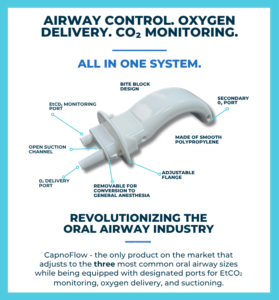
This is where CapnoFlow represents the next logical evolution. The research community has validated that active tongue displacement improves ventilation reliability and that non-cuffed, integrated designs can support clinical monitoring. CapnoFlow builds on these principles by combining:
- Optimized tongue displacement geometry — Similar to the AOA, CapnoFlow’s adjustable oropharyngeal design actively positions the tongue for superior patency without the need for a cuff.
- Dedicated EtCO₂ sampling port — Rather than improvising with adapters, CapnoFlow incorporates a purpose-engineered sampling channel that provides reliable, continuous capnography waveforms.
- Integrated oxygen delivery — Supplemental oxygen is built into the device, eliminating the need for separate delivery systems and streamlining the workflow.
- Integrated suction access — A dedicated suction port allows airway clearance without removing the airway—a practical advantage in long procedures.
- Reinforced bite-block functionality — Prevents occlusion and improves device stability.
The Clinical Value: From Evidence to Practice
The Abrons study illustrates that oropharyngeal airway design matters. When devices are thoughtfully engineered—focusing on active displacement and integrated functionality—they translate to measurable clinical benefits:
Better ventilation in high-risk patients — Patients who are obese or edentulous benefit from airway designs that provide greater mechanical advantage through articulation rather than just inflation. More reliable capnography — Clinicians need respiratory monitoring they can trust. CapnoFlow’s integrated design ensures reliable, continuous CO₂ waveforms, supporting safer anesthetic management. Reduced workflow friction — By integrating monitoring and oxygen into a standard oral airway form factor, CapnoFlow reduces the number of separate devices in the airway cart. Fewer airway manipulations — When an oropharyngeal airway actively controls tongue position and provides reliable oxygen and monitoring, fewer adjustments are needed during anesthesia.
Why Clinicians Should Care About Device Innovation
The Abrons study reminds us that device design is not a commodity. A small difference in mechanical advantage—whether through active tongue displacement or integrated functionality—can meaningfully improve outcomes in patients who are difficult to ventilate. For decades, the Guedel airway was the default. It still has a role. But as patient populations become more complex, airway devices need to do more. They need to provide active tongue control and integrate monitoring without adding the risks and bulk associated with cuffed devices. CapnoFlow addresses each of these needs by applying the validated principles from studies like Abrons et al. and taking them to their logical conclusion: a single, integrated device that solves multiple problems at once.
The Science Behind Integration
The Abrons et al. study demonstrates that advances in oropharyngeal airway design—specifically active tongue displacement—translate to measurable improvements in ventilation, especially in high-risk patients. The logical next step is to integrate the other critical functions that modern anesthesia demands: reliable capnography monitoring, oxygen delivery, and suctioning. CapnoFlow represents this evolution. By combining optimized airway geometry with integrated capnography, oxygen, and suction access, it addresses the complete picture of what clinicians need during airway management—all within a streamlined, non-cuffed design. The research validates the principles; thoughtful engineering delivers the solution. For anesthesia providers managing complex airways, the question is no longer “which basic airway do I reach for?” It’s “why would I reach for separate devices or cumbersome cuffed alternatives when integrated design offers better control, better monitoring, and better workflow?”
Comments are closed